Scaleforged begins with a human ambition: help Québec industries evolve while preserving jobs. We build around repetitive work because the value should reach the people doing it, including time for family and community. Experience and permitted knowledge from around the world inform what we create here. The studio’s goal is to retain the resulting locally created intellectual property and practical skills in Québec. This is the mission guiding the work ahead.
AI venture studio
Québec, Canada
Design commitments
02 / 14
More time for the people around us.
The mission is to modernize work without eliminating jobs.
Preserve jobs and human decisions
Useful skills that grow
Time for family and community
Speaker notes
Our mission is explicit: transform repetitive work without removing jobs. That starts with the affected team, including the people who know where effort, errors and frustration accumulate. The intended benefit must include their workload and agency, not only the amount of output. We want new tools to support useful skills and time outside work. Each deployment should evaluate what changed, including review effort and whether people gained usable time. We are stating a design commitment, not a measured employment result.
Development method
03 / 14
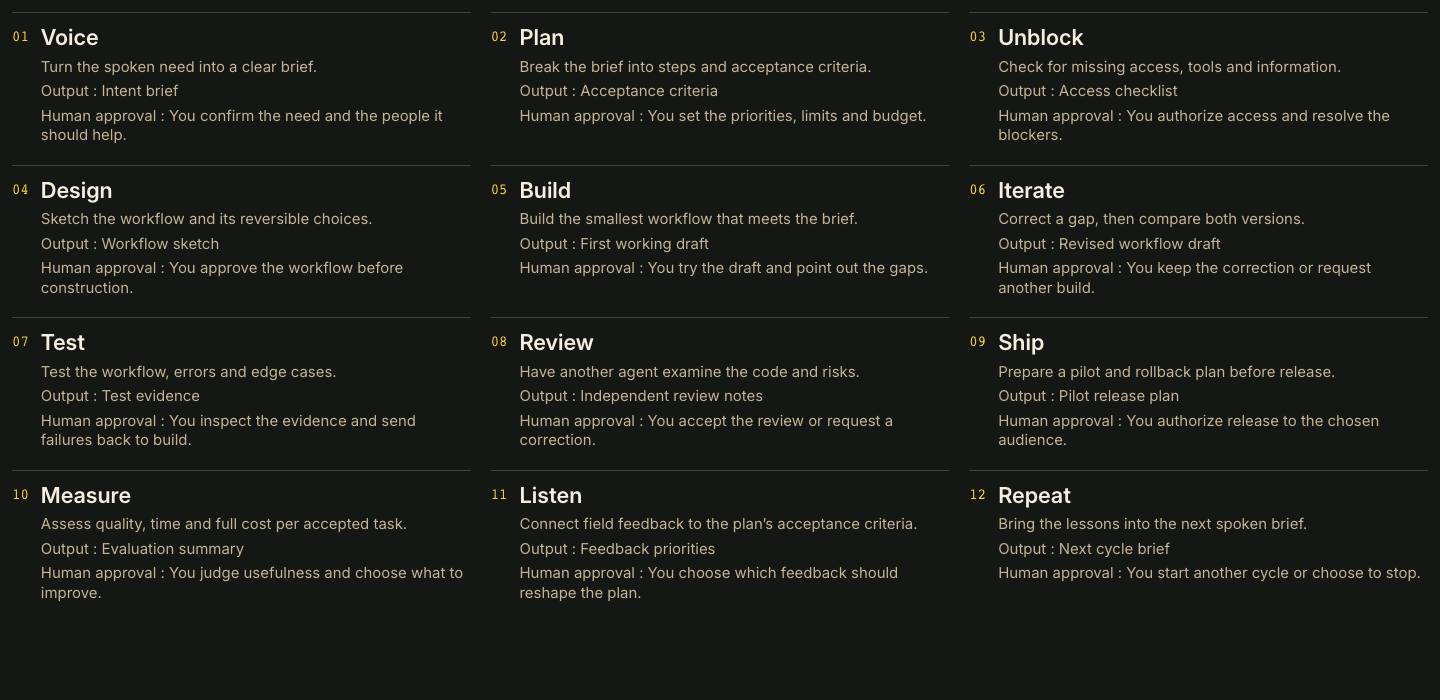
One cycle. Orchestrated agents.
Twelve stages. Specialized agents. People approve each next step.
Speaker notes
Begin with the task and the person responsible for it. Agree on the source information, what an acceptable result contains, and where a person must confirm a decision. Build the workflow, then compare its result with those expectations. Real use supplies corrections, review effort and evidence of value. A separate evaluation checks changes before release. The feedback can improve prompts, routing and tools without changing model weights. The same discipline applies to a product workflow and to the shared go-to-market capability.
Proposed evaluation
04 / 14
The useful result is the unit of value.
Count the full effort required for an accepted result.
Full operating cost per accepted result
Review effort and retained human control
Speaker notes
A low model price does not establish an economical workflow. Include tool calls, retries, compute, integration and the person’s review time. Compare those costs with accepted results and the burden on the team. A more powerful model can be appropriate for a difficult task, while a simpler route can be sufficient elsewhere. The studio should choose using evaluation evidence. Portability and greater control over processing remain development goals. The retained source does not establish independence from all providers or exclusively Canadian processing.
Seven products. Distinct stages.
05 / 14
Distinct missions. One connected ecosystem.
Each product has a role. Shared capabilities move the whole studio forward.
Shared engineering and evaluation.
Nota
Transform notarial services
Bring the client’s need closer to the notary’s decision.
nota: Bring the client’s need closer to the notary’s decision. Build an industry product where trust matters.
tablix: Turn RDPRM PDFs into structured documents a professional can verify. Prioritize a concrete paid workflow with review in the loop.
sst: Carry a worker’s observation into a reviewed action. Apply the studio’s capabilities to teams’ real work.
plainledger: Put each product’s indicators in context for better decisions. A shared performance product for the whole portfolio.
ursly: Explore more natural interaction through human senses and AI research. An R&D product preparing the next iteration and its funding.
controlcraft: Turn places, passions and memories into art. A commercial product to test sales, content and fulfillment. Revenue remains an objective.
devanture: Bring together storefront experience, live 3D negotiation and commercialization. One modular offering: standalone, as an intended Shopify alternative, or added to an existing store.
Each product has a role. Shared capabilities move the whole studio forward.
Local ownership goal
06 / 14
Global knowledge. Companies created in Québec.
Global knowledge and experience inform what we build in Québec. Our goal is to keep the IP we create here.
The studio’s ambition is to bring useful experience and knowledge from abroad into Québec industries. That can include permitted research, licensed tools and documented collaboration. It does not mean taking ownership of someone else’s technology by using it. We aim to retain the intellectual property the studio actually creates in Québec, with clear product ownership, contributor agreements and license records. The local value includes the practical skills developed with teams. The map expresses this ambition and does not claim an established international partner network.
Research and experience from around the world
New work and practical skills rooted here
Shared capability in development
07 / 14
Ralika, commercialization within Devanture.
A shared module to reach audiences, launch products and keep the connection.
Audience and timing
Understand the community, its need and the moment that makes the content relevant.
Content for the community
Prepare suitable visuals, useful metrics or demonstrations, and adapt the format to the channel.
Review and publication
People check the facts, the message and the customer promise before approving publication.
Behaviour and conversion
Observe agreed first-party events such as product views, voluntary inquiries and purchases, with clear consent choices.
Measured iteration
Compare variants, account for the full effort, and decide whether to continue, revise or stop.
Ralika, within Devanture, supports commercialization across the portfolio. Control Craft tests a near-term sales objective; DealBox is a nested market experiment within Devanture. These are proposed validation settings, not measured conversion results.
Speaker notes
We are developing a shared go-to-market agent that begins with a specific audience and the reason a product could matter to it. It prepares dynamic content, including visuals, relevant metrics or short demonstrations from permitted sources, in a suitable format and at a useful moment. People review the facts and approve publication. Agreed first-party behavior then links engagement to product views, qualified inquiries, checkout and purchase where relevant. The aim is to compare what helps customers act and adjust the next version. Include full acquisition effort and enough evidence to support each decision. This learning can improve content and routing without retraining model weights.
Ralika, within Devanture, supports commercialization across the portfolio. Control Craft tests a near-term sales objective; DealBox is a nested market experiment within Devanture. These are proposed validation settings, not measured conversion results.
Proposed business model
08 / 14
Revenue follows a recurring need.
The proposed studio model combines product businesses with reusable capabilities.
Subscriptions, usage or transaction fees
Shared engineering and go-to-market support
Each product earns its next investment
Speaker notes
The proposed business model builds revenue around the customer’s recurring need, through subscriptions, usage or transaction fees appropriate to each product. Shared engineering, evaluation and the GTM capability can reduce repeated setup effort, but the full economics must be measured. The retained plan proposes an investment in the studio, with product interests and IP assignments documented during diligence. Portfolio breadth does not establish consolidated revenue or ownership percentages. The C$0 additional POC-investment hypothesis is separate from the broader studio financing proposal.
Proposition to validate with customers
09 / 14
A place in the customer’s real work.
The product must earn adoption through local fit, reviewable results and useful full-cost economics.
A workflow adapted to the task
Results people can verify
Value that survives repeated use
Speaker notes
Customers already have ways to do the work. Manual processes are familiar. Generic tools offer flexibility, while established software brings existing relationships and distribution. Scaleforged’s proposition is a locally adapted workflow that keeps review and human authority visible. It must earn its place by reducing avoidable effort without shifting a larger burden onto the team. Validate integration, switching effort, willingness to pay and repeated use. This is a proposition to test with buyers, not an audited ranking of competing vendors.
Founder background
10 / 14
A proven venture studio model.
Founded in California. Replicated in Québec.
One shared studio. Multiple companies.
The studio brings resources together. Companies take shape.
CREE8 · California
Anthony Paquet
Founder in California
3years · Head of Engineering
ScaleForged · Québec
The model replicated in Québec.
Founder-reported background
Speaker notes
Anthony Paquet identifies as a founder in California, where he helped found and operate a venture studio model at CREE8. In his account, he operated it for three years while serving as Head of Engineering. That experience is the foundation for the model he is replicating in Québec through ScaleForged. A venture studio brings together a shared team, talent and resources to create multiple companies. The studio builds ventures alongside their founders, rather than treating each company as an isolated effort. Sharing resources creates a common foundation while giving each venture its own project. In Québec, Anthony is replicating that approach with local teams and founders. His background includes media and entertainment, live sports, video games and marketing. Anthony also cites CNN, Disney and NHRA as references from that background. These details support the founder story; the main message is the venture studio model founded in California and replicated in Québec.
Proposed decision criteria
11 / 14
The next investment follows the evidence.
Quality, human benefit, economics and paid use must all support expansion.
Source fidelity and accepted results
Human control, skills and workload
Full cost and repeated paid use
Documented rights
Speaker notes
A credible next step needs more than a working demo. Each product should establish a reviewable result, usable human control and an acceptable full cost. The mission also requires evidence about workload, useful skills and how people can use any time released. Commercial proof includes repeated use and willingness to pay. Document the rights behind software, content and data. For the GTM capability, separate engagement from qualified demand and purchases. These checkpoints guide staged investment. They are proposed gates, not a list of achieved outcomes.
Proposed targets
12 / 14
An 18-month plan to establish value.
Start with one accepted workflow and expand only with repeated paid use.
Months 0–3: one accepted workflow
Months 4–9: target five paid pilots
Months 10–18: target 25 paying organizations
Speaker notes
The retained plan starts with one accepted workflow and a baseline for quality, human control and full cost during months zero to three. Months four to nine target five paid pilots, initially in legal workflows, and evidence that people keep using the result. Months ten to eighteen target twenty-five paying organizations and C$20,000 in monthly recurring revenue. That revenue target assumes an unvalidated blended C$800 per organization per month. These are planning targets. Product expansion and GTM experiments should follow evidence rather than a fixed promise that every venture scales at once.
Investment discussions. No committed financing.
13 / 14
An investment shaped together
Investment amount, structure and timing are open for discussion, based on mutual fit, investor involvement and available capital.
Shared priorities
Investor involvement
Available capital and timing
Speaker notes
We welcome investment partners who share the studio’s mission. Investment amount, structure and timing are open for discussion, based on mutual fit, investor involvement and available capital. Budget scenarios are reserved for private discussions and shaped around the agreed scope and evidence milestones. Final terms, product interests and rights still need documentation. No financing is claimed committed or raised.
Invitation to collaborate
14 / 14
The next useful company starts with people.
Build a workflow with us that strengthens local skills and gives people more time.
The invitation is to begin with work that people know. Which task repeats, who carries the burden, and what would a useful result change for the team? Scaleforged wants to build with domain experts and organizations that share the mission of preserving jobs and making time for family and community. We bring permitted knowledge from the world into companies created here and aim to keep the resulting IP in Québec. The next step is a concrete workflow and evidence of value. Investment amount, structure and timing will be discussed with prospective partners according to shared priorities, involvement and available capital.